Beta Edition
Monday, 18 May 2026
WASHINGTON: In a major milestone for space exploration, NASA has successfully launched its Artemis II mission, sending humans toward the Moon for the first time in more than five decades.
The spacecraft lifted off from the Kennedy Space Center in Florida, marking the first crewed lunar mission since the Apollo 17 Moon Landing in 1972. The mission is being seen as a crucial step toward re-establishing a sustained human presence on the Moon.
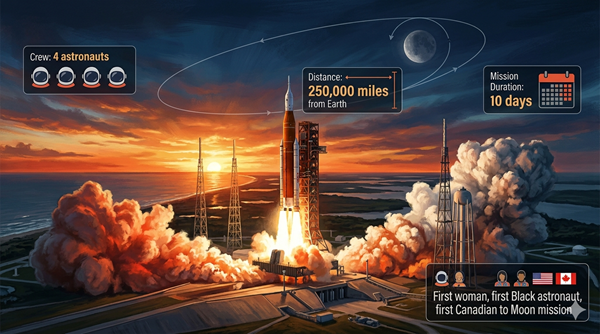
Artemis II is carrying a crew of four astronauts: Reid Wiseman, Victor Glover, Christina Koch, and Canadian astronaut Jeremy Hansen. The mission is notable for its diverse crew, including the first woman, the first Black astronaut, and the first non-American to travel on a lunar mission.
The approximately 10-day mission will take the spacecraft around the Moon before returning to Earth, without attempting a landing. Its primary objective is to test life-support systems, navigation, and overall spacecraft performance in deep space.
During the mission, the crew is expected to travel roughly 250,000 miles from Earth, making it one of the farthest human journeys into space in history.
According to NASA, Artemis II is a key part of the broader Artemis program, which aims to land astronauts on the Moon again and eventually pave the way for human missions to Mars.
Experts say the success of this mission will play a critical role in determining the timeline and feasibility of future missions, including a planned lunar landing under Artemis III.
The launch has drawn global attention, with scientists and space agencies viewing it as the beginning of a new era in human space exploration.