Beta Edition
Sunday, 24 May 2026
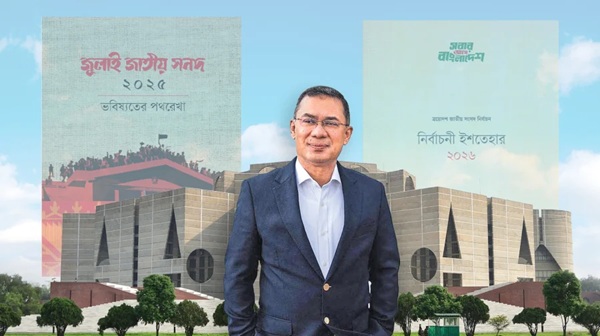
The referendum was won by a huge margin. Does that mean the July Charter is being implemented?
On what basis will the seats in the upper house be distributed? According to the PR system or proportionally to the number of seats in the lower house?
Will the upper house have the authority to approve constitutional amendments? Will Tarique Rahman be the prime minister and party chief at the same time? What is the future of the Note of Dissent?
These are the questions that keep coming up. Analysts say that the implementation of the July Charter will definitely be complicated. Even the legitimacy of the referendum may be questioned. Of course, there are also differences of opinion.
Writer and researcher Altaf Parvez believes that the implementation of the July Charter depends on political decisions.
He says, "If you think about it in general terms, they (BNP) will stick to what they have been saying in the consensus commission meeting. Now if the opposition party wants to do politics with this, there is also a chance for that."
Barrister Jyotirmoy Baruza has raised questions about the July Charter Gazette. According to him, the confusion remains in that gazette.
He says, "You will see that on November 13, the President's Order No. 2025, the order implementing the charter, has been gazetted. How did the President give the order? The President will issue an ordinance. There is a question of ordinance ratification. He issued it as an order without ratification. He has no jurisdiction to issue an order."
However, senior lawyer Abu Hena Razzaqi believes that it is an accepted decision. He says, "Why do these questions arise now whether we can or not? Because we have all accepted it. When the people accept it, there are no more questions. It is an accepted decision."
Consensus Commission on Disagreement
The consensus commission has been in place for almost nine months. The time has been extended three times, and discussions have taken place at meetings of 30 political parties.
The July Charter was created on this basis, although the participating political parties did not actually agree on the reform proposals.
Most of the proposals or recommendations have 'notes of dissent' or objections. The July Charter was signed with objections. But they do not exist in the question of the referendum.
The question arises: what is the future of the implementation of the July Charter? Which will be more important to the BNP, the charter or the manifesto?
The July Charter states with a 'note', 'Of course, if any political party or alliance obtains the mandate of the people as mentioned in the election manifesto, they will be able to take measures accordingly.'
Article 17 of the July Charter proposes that Bangladesh will have a bicameral legislature, consisting of a lower house (the National Assembly) and an upper house (the Senate).
BNP has no objection to this proposal. However, the party, which won the election with an absolute majority, has given a 'note of dissent' to the July Charter proposal regarding its formation process.
The July Charter proposal on the process of forming the upper house states that 100 members of the upper house will be elected through the proportional representation or PR system based on the votes received in the lower house elections. This means that the party that receives the percentage of total votes in the election will get the same percentage of seats in the upper house.
In this proposal, the BNP proposed with a 'note of dissent' that the upper house be formed using the proportional representation system of the lower house seats. That is, the political party that won the seats will get the same number of seats in the upper house.
In its manifesto, BNP also said that political parties will be represented in the upper house in proportion to the number of seats they won in the lower house.
Again, the second of the four questions of the referendum, namely 'B', stated, "The next National Parliament will be bicameral and an upper house will be formed with 100 members in proportion to the votes received by the parties in the National Parliament elections, and the approval of a majority of the members of the upper house will be required to amend the constitution."
Experts fear that legal complications will arise over the issue, as the referendum does not mention the Note of Dissention, and the July Charter allows for the Note of Dissention to be taken into account.
According to Barrister Jyotirmoy Barua, the consensus commission has effectively failed. He said, “The charter should have been made with only those things that were agreed upon. The rest should have been left to the elected parliament.”
However, senior advocate Abu Hena Razzaqi believes that there is no room for discussion on the 'note of dissent' since the 'yes' vote won the referendum. He said, "Whether you gave a note of dissent earlier or not will no longer be an issue. I think there will be no more debate on this from a party perspective or there should be."
July Charter or Manifesto?
Now, which path BNP will take is a 'million-dollar question'.
Researcher Altaf Parvez says, "What was presented in the referendum was passed. Then the BNP will say that we have been saying that in the consensus commission meeting. That means there is room for opposition here."
"The space for opposition has been created through the referendum process. I would say this is the 'contribution' of the interim government," added Altaf Pervez.
Barrister Jyotirmoy Barua says, "Can't he who has brought a huge mandate from the people in the parliamentary elections go to parliament and make decisions like he should? Can he be forced to?"
He said that there is no opportunity to force the parliament, "Now it will depend on the good sense of the BNP as to how much they will accept or not. There is actually not much opportunity to force it."
However, Advocate Abu Hena Razzaqi said, "The final decision is always final. The consensus commission did not reach a consensus because of the note of dissent. Otherwise, there would have been no need to go to a referendum. The decision would have been made. Since there was no consensus, it was sent to a referendum."
What will happen to the Constitutional Reform Council?
According to the current constitution, the constitution can be amended if it receives the support of two-thirds of the members of parliament. But the July Charter Implementation Order calls for the formation of a 'Constitutional Reform Council' to amend the constitution.
In the consensus commission discussions, Jamaat-e-Islami and NCP were in favor of the Reform Council, while BNP was against it.
Even some parties including Jamaat-e-Islami and NCP had proposed issuing an order, not an ordinance, to implement the charter. BNP said there was no scope for issuing such an order. The President can issue an ordinance.
However, the order has finally been issued. Accordingly, the members of the Constitutional Reform Council are supposed to be sworn in along with the members of parliament.
Barrister Jyotirmoy Barua fears complications with this too. He says, "The Constitutional Reform Council will make fundamental changes with those who won the existing constitution and entered parliament. Doesn't this become a conflict of interest?"
"If a council is formed and that council makes fundamental changes to the constitution again, the challenge will be whether they have the authority to make these fundamental changes or not," added Barrister Jyotirmoy Barua.
However, according to advocate Abu Hena Razzaky, Tarique Rahman's call for a "yes" vote led to so many votes. He now believes it is the BNP's moral responsibility.
He said, "They got a two-thirds majority in parliament. If they don't, that's a different matter. But if they won the referendum by a huge margin, then everything will have to be done in the same way as the referendum."
Subject referendum
Political analyst Altaf Parvez said, "The referendum process itself is questionable in many ways. It is a novel referendum. A referendum seeks the opinion of the people on an issue that has been left to parliament. This did not happen in that process."
He says, "I think many people outside the BNP will question the legitimacy of this process. The court could be an option here."
However, Barrister Jyotirmoy Barua wants to remain hopeful. He says, “All parties have given similar opinions on the basic issues of the July Charter that are under discussion and that need to be rationally reformed.”
Senior lawyer Abu Hena Razzakir fears that the situation could be adverse if the referendum is not implemented . He said, "If they (BNP) do as they think about the two-thirds majority, they can do it. If they do, we don't know whether the countrymen will accept it or not, what the situation will be."
All the 'notes of dissent' of BNP
The July Charter contains 84 proposals or recommendations. Of these, the Consensus Commission has identified 47 issues as 'reforms subject to constitutional amendment' and the remaining 37 issues as 'reforms through laws/ordinances, rules and executive orders'.
BNP has given notes of dissent on 24 of the 47 proposals for reforms subject to constitutional amendment. And its party's position on those issues has been made clear in its election manifesto.
Constitutional Amendment
According to the July Charter, constitutional amendments require the support of two-thirds of the lower house of parliament and a majority of the upper house. In some cases, a referendum will be required.
The BNP's proposal, through its note of dissent, is that the upper house will not have any jurisdiction regarding constitutional amendments.
Balance of power between the President and the Prime Minister
The July charter proposes that the president can appoint the head and other members of the Human Rights Commission, Information Commission, Press Council, Law Commission, Energy Regulatory Commission, and the Governor of Bangladesh Bank without consulting anyone.
BNP has objections to the appointment of the Bangladesh Bank Governor and BERC under the jurisdiction of the President. However, BNP's election manifesto promises to bring balance to the power of the President and the Prime Minister.
Prime Minister's term
According to the July Charter, if the constitution is amended, a person will be able to remain prime minister for a maximum of ten years. The BNP has no objection to this proposal.
However, according to Clause 15 of the charter, the Prime Minister and the party chief cannot be the same person. BNP, in a 'note of dissent' to this proposal, said that the same person can be the Prime Minister and the party chief.
The party has also mentioned the issue again in its election manifesto.
Caretaker government system
The 16th clause of the July Charter calls for the formation of a five-member committee from within Parliament to select the chief advisor to the caretaker government. The process has also been specified.
However, BNP has objections to the involvement of the judiciary in the committee in 16(9) points. Even the BNP has proposed to determine this level through the National Parliament by giving a note of dissent regarding the selection of the chief advisor through the 'ranked choice' method in the secret ballot of those seven members.
In its manifesto, BNP has made it clear that the judiciary and the president will be kept out of the caretaker government system.
Upper House structure
The July Charter proposal on the process of forming the upper house states that 100 members of the upper house will be elected through the proportional representation or PR system based on the votes received in the lower house elections. This means that the party that receives the percentage of total votes in the election will get the same percentage of seats in the upper house.
In this proposal, the BNP proposed by giving a note of dissent that the upper house would be formed using the proportional representation system of the lower house seats. That is, the political party would get seats in the upper house in the same proportion as the seats it won.
Responsibilities and Roles of the Upper House
According to Clause 19 of the July Charter, the Upper House will review the laws proposed by the Lower House. Except for money bills and confidence votes, all bills must be sent to the Upper House for approval.
BNP's position in this phase is that the upper house will not have jurisdiction over constitutional amendments, money bills, confidence votes, and national security (war situation) bills. The same has been mentioned in their manifesto.
Article 70
The July Charter proposed amending Article 70 of the Constitution on issues of voting against the party, stating that members of Parliament would be loyal to their party only in money bills and votes of confidence. They would be able to vote independently on any other issue.
However, BNP issued a 'note of dissent' saying that members of parliament will not be able to vote against the party even on constitutional amendments and national security (war situations).
Judiciary
The 29th clause of the July Charter proposes that the senior-most judge of the Appellate Division will be the Chief Justice. However, the BNP has issued a 'note of dissent' saying that the President can appoint any of the two senior-most judges as the Chief Justice.
Regarding the appointment of judges, the July Charter proposal calls for the formation of an independent Judicial Appointments Commission headed by the Chief Justice.
However, in a 'note of dissent', BNP said that a law will be made regarding the appointment of Supreme Court judges.
The 34th clause of the July Charter allows for the establishment of one or more permanent benches in each division with the approval of the President.
However, BNP is in favor of making a decision on this after discussing it with the Supreme Court.
There is a proposal to include a provision regarding the formation of a permanent attorney service in the constitution in clause 37 of the July Charter. However, the BNP says that it can be implemented at the district level in phases through legislation rather than including it in the constitution.
Appointment to constitutional institutions
There are proposals to include the appointment of the Ombudsman, three separate Public Service Commissions, the Auditor General and Comptroller and the Anti-Corruption Commission in the constitution. However, the BNP, which has issued a 'note of dissent' to all four proposals, said that a law will be formulated to determine the process of these appointments.
The BNP's election manifesto states that the Public Service Commission will be transformed into a strong structure suitable for recruitment in education, health and general (all other sectors).
Local government
Clause 88 of the July Charter states that the issue of holding elections to local government institutions at the decision of the Election Commission will be added to the constitution.
BNP agrees with this proposal. However, disagreeing with the proposal to include it in the constitution, the party said that it is better to do it through law.
BNP agrees in principle with local government institutions collecting their own funds under Article 47 of the charter, but disagrees with the addition to the constitution. At the same time, the party has a note of dissent saying that any budget-related issue has no relevance to the upper house.
The BNP's election manifesto also states that local government elections will be held under the direct supervision of the Election Commission. Necessary laws will be formulated for this.
What is the solution?
Altaf Parvez believes that in this situation, everything depends on the political wisdom of the ruling party and the opposition.
He said, "If the BNP wants, it can pass it by majority or go to court. On the other hand, the opposition party can make concessions if it wants."
However, researcher Altaf Parvez does not expect this to happen in the current political culture.
He says, "In Bangladesh, it doesn't happen that such a generous win-win situation will happen. Rather, both sides may end up in a lose-lose situation."
He believes, "Those who initiated the referendum have left an opportunity for conflict here. But when this conflict occurs, they will remain behind the scenes, they will not have to share the blame."
Altaf Parvez believes that BNP has two options: to pass everything with a majority or to leave it to the courts.
"There will definitely be a political debate about this," added Altaf Pervez.
Regarding the future of the referendum, advocate Abu Hena Razzaqi says, "If they (BNP) don't evaluate it, what will be the consequences? Time is the best judge."