Beta Edition
Thursday, 09 Apr 2026
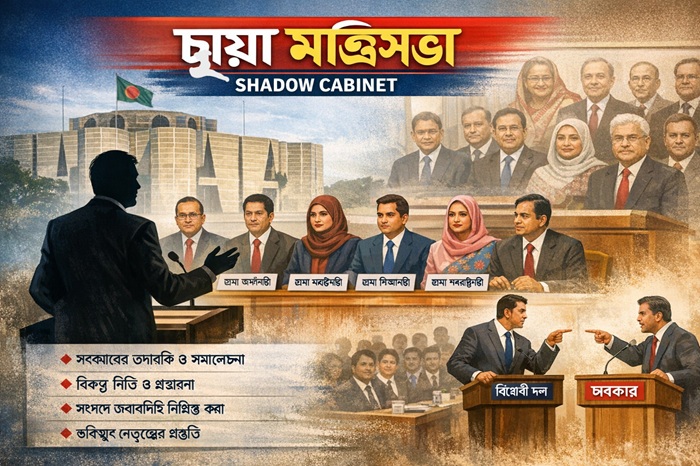
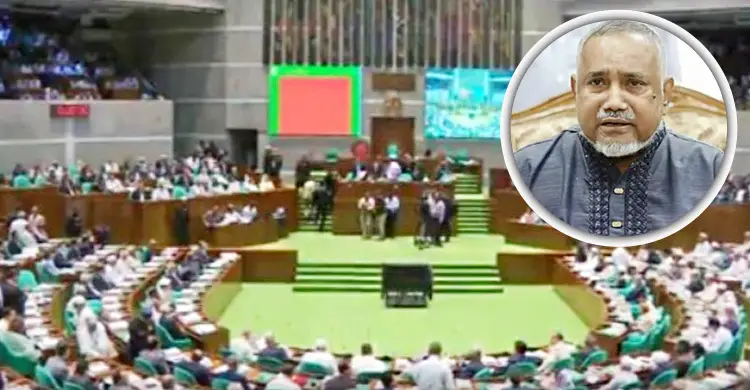
The 'shadow cabinet' has suddenly become a topic of discussion in the country's political arena. This discussion was sparked by the announcement of the formation of a 'shadow cabinet' by the leaders of Jamaat-e-Islami and NCP on the eve of the formation of the BNP government. Many people are asking, what is a shadow cabinet? How effective is it in a parliamentary democracy?
Last Saturday (February 14) night, Jamaat-e-Islami's Sunamganj-2 (Dirai-Shalla) candidate Shishir Monir announced in a post on his verified Facebook page, "We will form a shadow cabinet, InshaAllah." After his announcement, renewed interest was generated among political circles and the general public.
Then, National Citizens Party (NCP) spokesperson Asif Mahmud Sajib Bhuiyan also made a similar statement. He wrote on Facebook on Sunday (February 15) morning, "We are preparing to form a shadow cabinet. The shadow cabinet will act as a watchdog to ensure transparency and accountability and oversee the overall activities."
What is a shadow cabinet?
The 'shadow cabinet' could be a new democratic practice in the country's politics.
A 'shadow cabinet' can play a role in ensuring government accountability.
The UK Parliament website states that the 'shadow cabinet' is a team of senior leaders selected by the leader of the opposition party who serve in parallel with the government's cabinet. Each member of the shadow cabinet is given responsibility for a specific policy area by the party and questions and challenges the activities of the minister concerned in that area. In this way, the government opposition party tries to present itself as an alternative 'government in waiting'.
According to political analysts, the shadow cabinet is not just a tool for criticism. It also serves as a kind of training ground for opposition party leaders, where party members gain practical experience about the administrative structure, budget, and policy-making processes—which helps them prepare for future government formation.
This system is most common in the Westminster-style democracy based in the United Kingdom. The country's shadow cabinet regularly monitors the activities of the government and ensures accountability by questioning ministers in parliament. Similarly, in Australia, the shadow cabinet plays an important role in reviewing government decisions.
Bangladesh context
There is no provision for a shadow cabinet in the Bangladeshi constitution. As a result, it is completely dependent on the initiative of political parties. In the past, major political parties have informally given sector-specific responsibilities to some leaders while they were in the opposition, but this has not been given a permanent or well-organized structure.
According to political analysts, this system has not been effective due to the culture of parliamentary boycott, intense political polarization, and limitations in parliamentary practice.
According to experts
, if the parliamentary culture in Bangladesh becomes more institutionalized and participatory, the shadow cabinet could become an effective political practice. However, it will depend on political will and mutual trust.
Shadow Cabinet - Still a concept in Bangladesh; however, if democratic practices are strengthened, it can also take shape as a real structure.
The Tarique Rahman-led BNP is going to form the government after winning an absolute majority in the 13th National Parliament election on February 12. They got 209 seats. On the other hand, the opposition alliance led by Bangladesh Jamaat-e-Islami got 77 seats. Out of these, Jamaat alone got 68. The cabinet members of the new government are going to take oath next Tuesday (February 17).